Total loss at 75%
Car insurance claim rules in Michigan
How long a Michigan insurer has to pay, when a damaged car must be branded salvage, how no-fault changes who pays, and the time limits to sue.
By Valoroath Editorial Team Updated 6 min read
In plain terms
Michigan sets its claim clock through interest. An insurer must tell you in writing, within 30 days of getting your claim, what counts as proof of loss, and a claim it pays more than 60 days after proof of loss carries 12% simple interest. No-fault personal protection insurance (PIP) benefits are overdue 30 days after the insurer gets reasonable proof. A late-model car that would cost 75% or more of its value to fix gets a salvage title, and at 91% a scrap title. Michigan is a no-fault state, and you generally have 3 years to sue for injury or property damage, but only 1 year for PIP benefits unless you give written notice in time.
- Total loss rule
- Repairs at 75% of value
- Insurer must decide
- Pay 60 days after proof
- Deadline to sue
- 3 years; PIP 1 year
- Fault system
- No-fault (PIP)
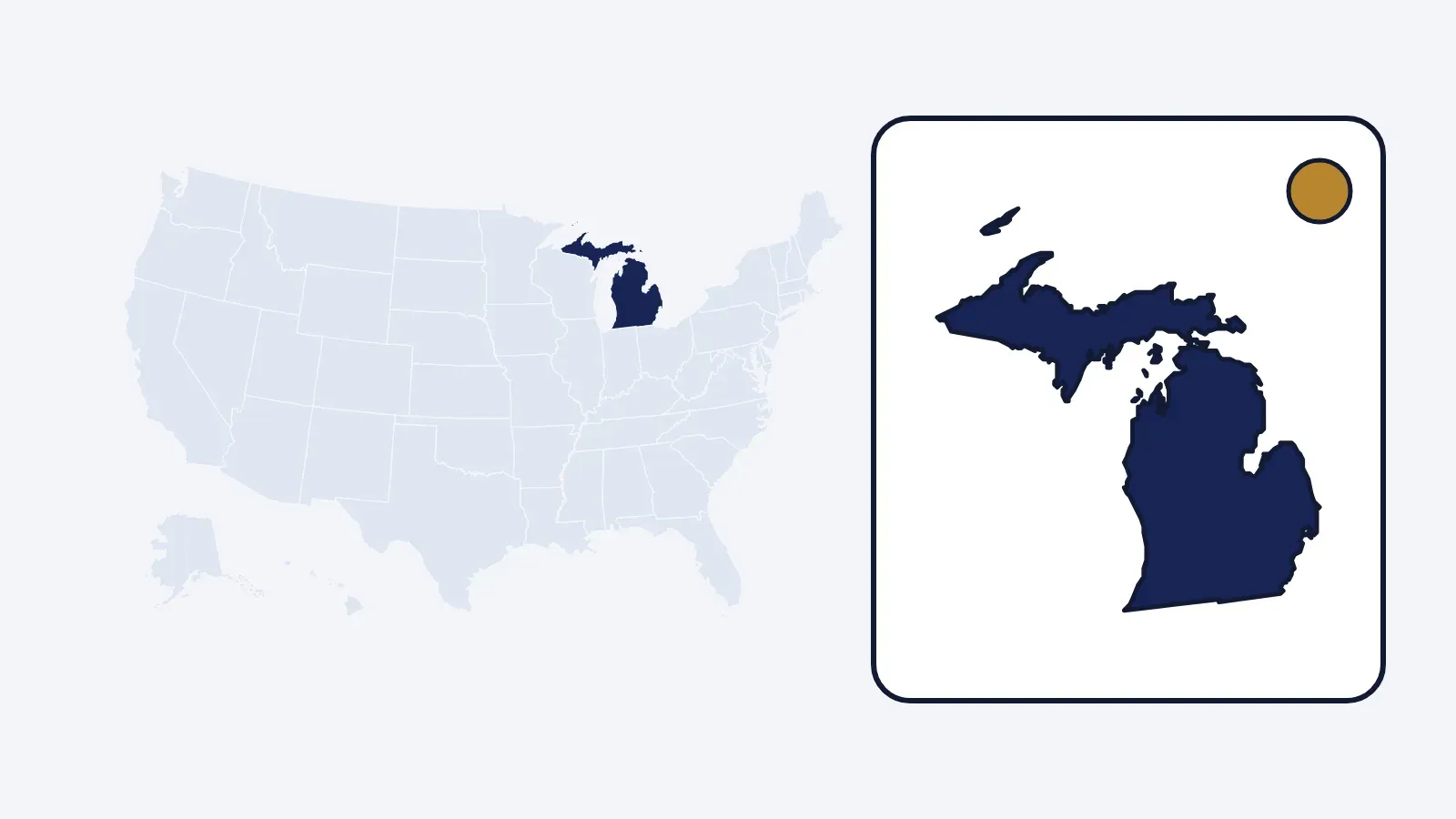
Michigan claim rules on one sheet
- Total loss rule Late-model cars: salvage title from 75% of value, scrap title at 91% or more Title law, MCL 257.217c. Late model: current or 5 prior model years (up to 8,000 lb). Insurers may total a car sooner.
- Insurer must acknowledge No fixed number; 'promptly' (MCL 500.2026) The insurer must list what counts as proof of loss within 30 days of the claim (MCL 500.2006).
- Insurer must decide Pay within 60 days after proof of loss, or 12% interest PIP benefits are overdue 30 days after reasonable proof (MCL 500.3142). Coverage decisions: 'a reasonable time.'
- Deadline to sue 3 years for injury and for property damage; 1 year for PIP benefits
- Fault system No-fault (PIP required); no pain-and-suffering award if more than 50% at fault
- Police report needed Right away if anyone is hurt or killed, or damage looks like $1,000 or more
- State crash report None from drivers; police send the UD-10 crash report to the State Police
A summary by Valoroath of the state's statutes and regulations, not an official document. The sources are listed at the end of this page.
How fast a Michigan insurer must act
Section 2006 of the Michigan Insurance Code requires insurers to pay claims on a timely basis. Section 2026 lists unfair claim practices, including failing to acknowledge claims promptly and failing to affirm or deny coverage within a reasonable time after proof of loss is complete. Section 2026 does not set a number of days; the numbers come from Section 2006 and, for PIP, from Section 3142.
| Step | Deadline | Section |
|---|---|---|
| Tell you in writing what counts as proof of loss | 30 days after the claim | MCL 500.2006(3) |
| Pay the amount your proof of loss supports | 60 days after proof of loss, or 12% interest | MCL 500.2006(3)–(4) |
| Pay PIP benefits | 30 days after reasonable proof, or 12% interest | MCL 500.3142 |
| Acknowledge the claim; affirm or deny coverage | Promptly; within a reasonable time | MCL 500.2026 |
The 60-day clock starts with proof of loss, so send what the insurer lists and keep dated copies. A claim that is reasonably in dispute is not late. If you are the other driver's claimant rather than the policyholder, interest applies only when liability is not reasonably in dispute and a court has found the insurer refused in bad faith. Steps that move a stalled file are in claims that drag on.
When a Michigan car is a total loss
Michigan's title law, MCL 257.217c, sorts late-model cars by the estimated cost of repair compared with their actual cash value just before the damage. A late-model car is one from the current model year or the five model years before it, for vehicles up to 8,000 pounds. Actual cash value means the retail value from an objective vehicle evaluation.
- 75% up to 91%: the insurer that takes the car must apply for a salvage title, and can't sell the car until it has one.
- 91% or more: the car gets a scrap title and can't return to the road.
- You keep the car: the insurer has you sign the salvage or scrap title application, and you can't sell the car until that title is issued.
- The payout is a separate question. The title rule doesn't set the settlement; what actual cash value should include is in total loss claims.
An insurer can still total a car below 75% when repairs plus salvage value come close to its value. The total loss check runs your estimate against the Michigan line.
Reporting a Michigan crash
Under MCL 257.622, a driver in a crash that injures or kills anyone, or damages property to an apparent total of $1,000 or more, must report it right away to the nearest or most convenient police station or officer.
Drivers don't file a separate report with the state. Police agencies send qualifying crash reports, form UD-10, to the Michigan State Police, which says processing can take 3 to 30 days. You can then buy a copy through the Traffic Crash Purchasing System, and your insurer will usually ask for the report number.
No-fault, PIP and the mini-tort
Michigan is a no-fault state. Your own PIP coverage pays your medical bills and lost wages after a crash, whoever caused it. You can sue the at-fault driver for pain and suffering only if the injury causes death, serious impairment of body function or permanent serious disfigurement, and you get nothing for it if you were more than 50% at fault. Our page on PIP and MedPay claims explains how those benefits are paid.
- Damage to your car is paid by your own collision coverage, not by the other driver's insurer.
- The mini-tort: for crashes after July 1, 2020, you can recover up to $3,000 of vehicle damage your insurance doesn't cover, such as your deductible, from the at-fault driver.
- Where to file it: the law says a mini-tort case must start in small claims court whenever legally possible; see small claims court after an accident.
- No coverage, no claim: no mini-tort damages are owed if your own car was driven without the required insurance.
Deadlines to sue and where to complain
Under MCL 600.5805, a suit for injury to a person or property generally must be filed within 3 years. PIP has a shorter clock: MCL 500.3145 bars a suit for PIP benefits filed more than 1 year after the crash unless you gave the insurer written notice of the injury within that year or it already paid benefits, and even then you can't recover losses incurred more than 1 year before you sue.
- Write to the insurer and ask for the reason for a denial or delay and the policy language behind it.
- Call the Department of Insurance and Financial Services (DIFS) toll-free at 877-999-6442, Monday through Friday, 8 a.m. to 5 p.m.
- File a complaint with DIFS online if deadlines pass or answers don't come; our guide to insurance department complaints shows what to include.
Questions people ask
How long does a Michigan insurer have to pay a claim?
It must list what counts as proof of loss within 30 days of your claim. A claim paid more than 60 days after proof of loss earns 12% simple interest unless it is reasonably in dispute. PIP benefits are overdue 30 days after reasonable proof.
What percentage of damage totals a car in Michigan?
For late-model cars, repairs of 75% up to 91% of the car's actual cash value mean a salvage title, and 91% or more means a scrap title. An insurer can total a car at a lower share.
What is the Michigan mini-tort?
A claim against the at-fault driver for up to $3,000 of damage to your car that your insurance doesn't pay, for crashes after July 1, 2020. It is filed in small claims court whenever legally possible.
How long do I have to sue after a car accident in Michigan?
Generally 3 years for injury or property damage under MCL 600.5805. A suit for PIP benefits must be filed within 1 year of the crash unless you gave written notice or benefits were paid.
Sources on record
- Michigan Compiled Laws 500.2006 — Timely payment of claims; interest
- Michigan Compiled Laws 500.2026 — Unfair claim settlement practices
- Michigan Compiled Laws 500.3142 — Overdue PIP benefits
- Michigan Compiled Laws 500.3135 — Tort threshold, fault bar and mini-tort
- Michigan Compiled Laws 500.3145 — Time limit for PIP suits
- Michigan Compiled Laws 257.217c — Salvage and scrap titles
- Michigan Compiled Laws 257.24b — Late model vehicle
- Michigan Compiled Laws 257.622 — Report of accident to police
- Michigan Compiled Laws 600.5805 — Limitations for injury to persons or property
- Michigan State Police — Traffic Crash Reporting Unit (UD-10)
- Michigan Department of Insurance and Financial Services — Auto insurance
Facts on this page were checked against these sources on November 11, 2026. The mini-tort cap applies to crashes after July 1, 2020; earlier crashes had a $1,000 cap.
Ask a licensed agent to review your coverage
After a claim, the policy you had is the one you can still change. Describe your situation and Valoroath passes it to licensed insurance agents and insurers who can review your coverage and quote, if you want them to. Valoroath itself does not sell insurance or handle claims.
- 1 Five questions about your car, your record and your policy.
- 2 Who to ask for, and your consent to be contacted.
- 3 A licensed insurance agent or insurer reviews what you have. You change nothing unless you choose to.
Sending this request shares your answers and contact details with the licensed insurance agents and insurers who receive it, which some state privacy laws treat as a sale; see your privacy choices. An agent reviews your coverage; they can't take on your claim or a dispute with your insurer. You pay Valoroath nothing. The licensed insurance agents and insurers who contact you pay Valoroath for requests and set their own prices and terms; your claim stays with your insurer. How we make money.
Next in the file
-

How claims work
PIP and MedPay claims
How your own policy pays medical bills after a crash, how no-fault thresholds work, and the deadlines.
-

Claim dispute
Complaining to your state
When a complaint helps, how to find your insurance department, what to include, and what it can and can't do.
-

After a crash
When to call the police
The cases for 911, state damage thresholds from $50 to $4,000, and why a report helps after a small crash.