Total loss at 75%
Car insurance claim rules in Alabama
The deadlines an Alabama insurer has to meet on your claim, when a damaged car counts as a total loss, what to report after a crash, and how long you have to sue.
By Valoroath Editorial Team Updated 6 min read
In plain terms
Alabama's claim deadlines are in a Department of Insurance rule. On a claim under your own policy the insurer has 15 days to acknowledge it and 30 days after proof of loss to accept or deny it, or the time your policy sets, and 30 days to pay once the amount is agreed. A car is a total loss for title purposes when the damage reaches 75% of its fair retail value. Alabama is an at-fault state whose courts apply contributory negligence, and most crash lawsuits must be filed within two years.
- Total loss rule
- Damage at 75% of value
- Insurer must decide
- 30 days after proof
- Deadline to sue
- 2 years
- Fault system
- At-fault
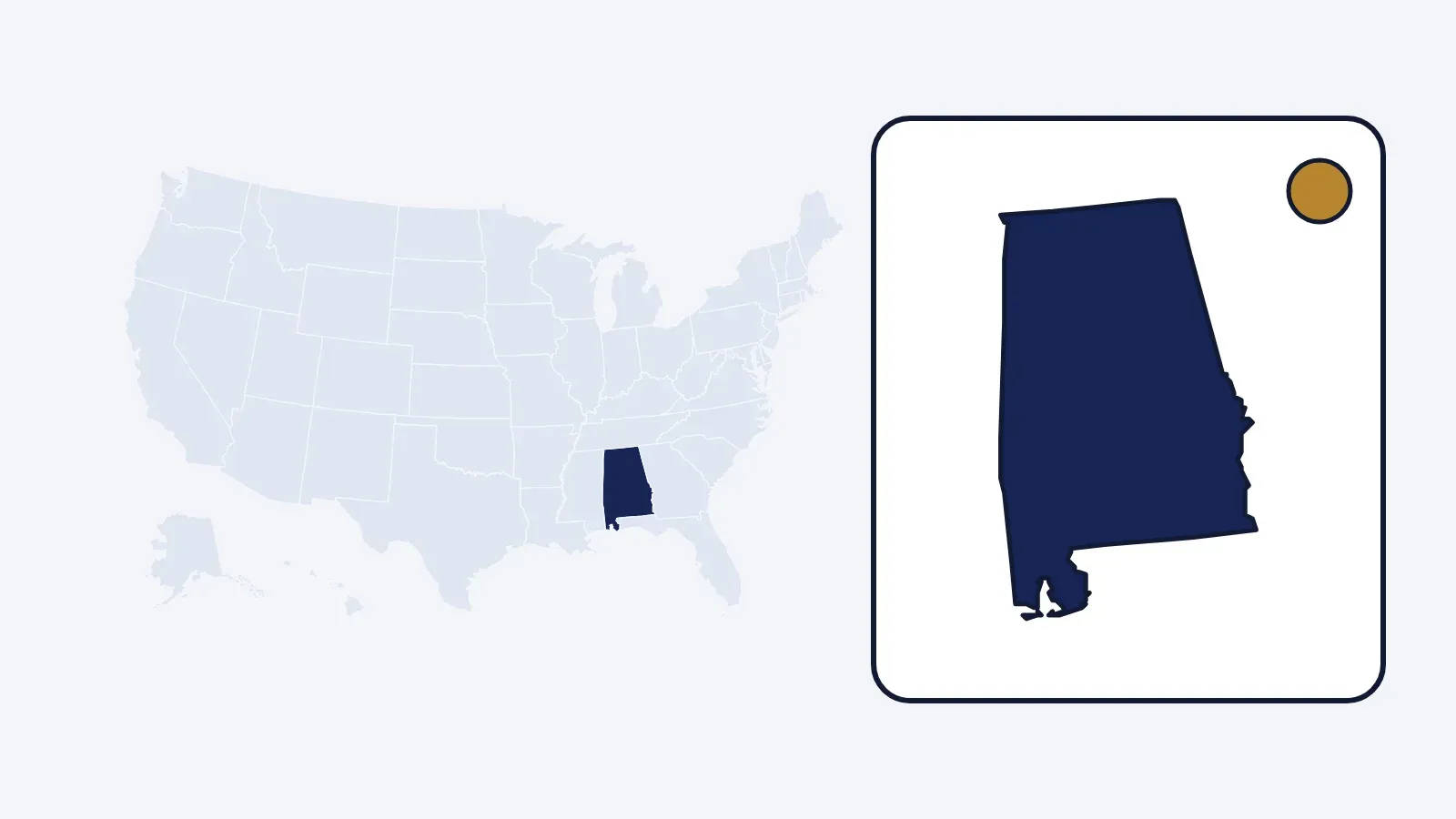
Alabama claim rules on one sheet
- Total loss rule Damage at or above 75% of fair retail value Salvage title law, Ala. Code §32-8-87(d). Minor theft or vandalism damage is not a total loss.
- Insurer must acknowledge 15 days after notice of a first-party claim
- Insurer must decide 30 days after proof of loss, or the policy's time; written reasons if longer Then 30 days to pay once liability and amount are agreed. Ala. Admin. Code 482-1-125-.07.
- Deadline to sue 2 years for injury and for property damage
- Fault system At-fault; contributory negligence can bar any recovery
- Police report needed At once if anyone is hurt or killed
- State crash report Driver files within 30 days: injury, death or damage over $250 Motor Vehicle Safety-Responsibility Act, Ala. Code §32-7-5.
A summary by Valoroath of the state's statutes and regulations, not an official document. The sources are listed at the end of this page.
The clock on an Alabama claim
Chapter 482-1-125 of the Alabama Administrative Code sets standards for how property and casualty insurers handle claims. Most of its day counts protect first-party claimants, meaning you when you claim under your own collision, comprehensive, medical payments or uninsured motorist coverage. Several rules, such as the payment deadline, are written for any claimant.
| Step | Deadline | Rule |
|---|---|---|
| Acknowledge a first-party claim, unless it is paid sooner | 15 days after notice | 482-1-125-.06(1) |
| Send claim forms, instructions or help | 15 days | 482-1-125-.06(4) |
| Accept or deny a first-party claim | 30 days after proof of loss, or the time in the policy | 482-1-125-.07(1) |
| Explain why more time is needed, then update you | Within the same 30 days, then every 45 days | 482-1-125-.07(2) |
| Pay once liability and the amount are settled | 30 days, or the time in the policy | 482-1-125-.07(6) |
The decision clock starts when the insurer receives a properly completed proof of loss, so send what it asks for quickly and keep dated copies. If you have no lawyer, the rule also asks the insurer to warn you about 45 days before the deadline to sue on a first-party claim runs out. When a file stalls past these limits, our page on claims that drag on shows how to press for an answer in writing.
When an Alabama car is a total loss
Under the salvage title law, Section 32-8-87 of the Code of Alabama, a total loss occurs when an insurer or anyone else pays a settlement on a car whose damage is greater than or equal to 75% of its fair retail value before the damage. Minor damage from theft or vandalism does not count. The car then needs a salvage certificate, and the insurer that takes it must get the title from you when it pays.
- Comparable car. For a first-party total loss, the insurer may offer a comparable car of the same make, same or newer year, similar body style, options and mileage, or pay what such a car actually costs, less your deductible.
- Taxes and fees. The settlement includes taxes, license fees and transfer fees, capped at what would have been paid on your car at the time of settlement.
- Itemized deductions. Any deduction, including for salvage, must be itemized and measurable, and a settlement that departs from these methods must be backed by documentation of the car's condition.
The total loss check applies the 75% line to your repair estimate and the car's value. How actual cash value should be built is in our guide to total loss claims.
Reporting an Alabama crash
Section 32-10-5 of the Code of Alabama requires the driver in a crash that injures or kills someone to notify the police at once, by the quickest means available: the city police inside a city, otherwise the county sheriff or the state highway patrol. The section sets no dollar threshold for damage-only crashes, but a police report still gives your insurer a neutral record.
A second duty is easy to miss. Under the Motor Vehicle Safety-Responsibility Act, Section 32-7-5, the driver must file a written accident report with the state within 30 days when a crash injures or kills someone or causes more than $250 of damage to any one person's property. The state uses it to check whether the drivers had insurance. Officers who investigate a crash send their own report to the state within 24 hours of finishing.
Fault, contributory negligence and who pays
Alabama is an at-fault state: the driver who caused the crash, through their liability insurance, pays for the damage and injuries they caused. Alabama courts still apply contributory negligence, a strict, all-or-nothing rule. If you were even slightly at fault, the other driver's insurer can argue that you recover nothing from it.
- Your own coverage matters more. Collision coverage pays for your car whoever was at fault, minus your deductible. Your insurer can then seek its money from the other side.
- Uninsured motorist coverage pays when the at-fault driver has no insurance or too little; see uninsured motorist claims.
- Watch what you say. Because a small share of fault can matter so much, stick to facts with the other insurer's adjuster.
Deadlines to sue and where to complain
Section 6-2-38(l) of the Code of Alabama gives two years to sue for an injury to a person or to the rights of another that does not arise from a contract, which covers most crash claims for injuries and damage. A wrongful death claim also has two years. Talks with an adjuster do not stop the clock.
- Ask the insurer in writing for the reason for a denial or a low offer and the policy language it relies on.
- Contact the Alabama Department of Insurance at 334-241-4141 on weekdays from 8 a.m. to 5 p.m.
- File a complaint with the department online, or mail its complaint form to P.O. Box 303351, Montgomery, AL 36130-3351. Our guide to insurance department complaints shows what to include.
Questions people ask
How long does an Alabama insurer have to settle a car insurance claim?
On a claim under your own policy, it must acknowledge the claim within 15 days, accept or deny it within 30 days after receiving proof of loss (or the time the policy sets), and pay within 30 days once liability and the amount are agreed.
What percentage of damage totals a car in Alabama?
For title purposes, a car is a total loss when an insurer pays on damage greater than or equal to 75% of its fair retail value before the damage. The car then needs a salvage certificate.
Do I have to file an accident report in Alabama if the police came?
The state's Safety-Responsibility Act asks the driver to file a written report within 30 days when a crash causes an injury, a death or more than $250 of damage to one person's property. That duty is separate from the officer's report.
Can I recover anything in Alabama if I was partly at fault?
Alabama courts apply contributory negligence, so a driver found partly at fault can be barred from recovering from the other driver. Your own collision and medical payments coverage still pay under your policy terms.
Sources on record
- Alabama Administrative Code, Chapter 482-1-125 — Standards for property/casualty insurance claims
- Alabama Department of Revenue — Salvage and rebuilt vehicles (Code of Alabama §32-8-87, 75% rule)
- Code of Alabama §32-10-5 — Immediate reports of accidents
- Code of Alabama §32-7-5 — Accident reports under the Motor Vehicle Safety-Responsibility Act
- Code of Alabama §6-2-38 — Two-year limitation periods
- Alabama Department of Insurance — File a consumer complaint
Facts on this page were checked against these sources on November 11, 2026. The day counts in chapter 482-1-125 apply mainly to claims under your own policy; your policy can set its own time limits.
Ask a licensed agent to review your coverage
After a claim, the policy you had is the one you can still change. Describe your situation and Valoroath passes it to licensed insurance agents and insurers who can review your coverage and quote, if you want them to. Valoroath itself does not sell insurance or handle claims.
- 1 Five questions about your car, your record and your policy.
- 2 Who to ask for, and your consent to be contacted.
- 3 A licensed insurance agent or insurer reviews what you have. You change nothing unless you choose to.
Sending this request shares your answers and contact details with the licensed insurance agents and insurers who receive it, which some state privacy laws treat as a sale; see your privacy choices. An agent reviews your coverage; they can't take on your claim or a dispute with your insurer. You pay Valoroath nothing. The licensed insurance agents and insurers who contact you pay Valoroath for requests and set their own prices and terms; your claim stays with your insurer. How we make money.
Next in the file
-

How claims work
Total loss claims
When a car is totaled, what actual cash value should include, and what happens to the loan and the title.
-

Claim dispute
Complaining to your state
When a complaint helps, how to find your insurance department, what to include, and what it can and can't do.
-

After a crash
When to call the police
The cases for 911, state damage thresholds from $50 to $4,000, and why a report helps after a small crash.